Tickets for our 40th Season
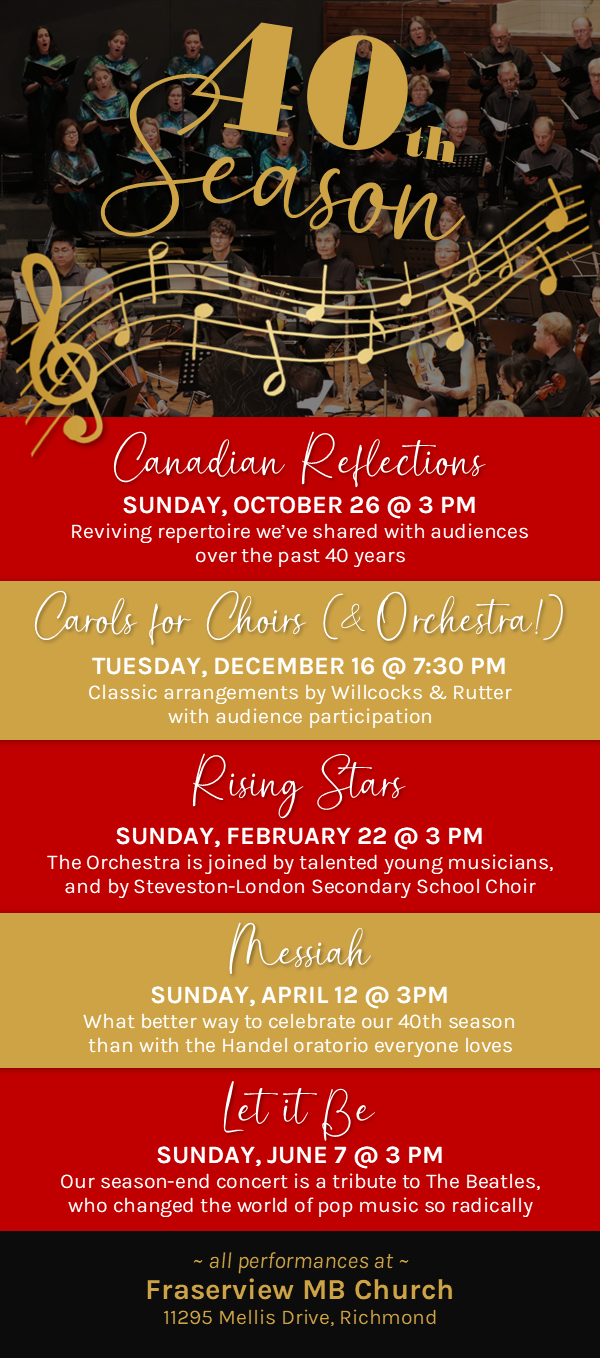
We are excited to offer a highly discounted Season Ticket Package for 2025-2026!
For only $15 per concert you can attend all 5 performances in our 40th season. At $75 that’s $50 off our “at the door” price!
Don’t miss this fantastic opportunity to enjoy the high quality live orchestral and choral music that ROCA offers here in the lower mainland.
Email us or give us a call to reserve your season ticket packages today!
2024-2025 Season Ticket Information
Season Ticket Packages for 2024-2025
All 5 of our concerts for $75 (that’s $15 per show - our best deal of the year!)
If you would like to reserve your season package, email roca@roca.ca and give your name and how many packages you would like to reserve. The tickets will be at Will Call at our first concert on October 26. You can pay by cash, cheque or credit card in person.
Tickets for each Concert
We sell our tickets for each concert at least one month in advance of the show. Tickets purchased online reflect a discount. Tickets at the door on the day of the performance are always $25 for all adults. Children and youth aged 16 and under are FREE!
The prices for this season are as follows:
Adult General Admission - $23
Senior / Student - $20
6 or more tickets purchased at once - $16 each
In-person at the door on day of performance - $25
Children/Youth aged 16 and under are always free!
Questions? Email us at roca@roca.ca for more info.










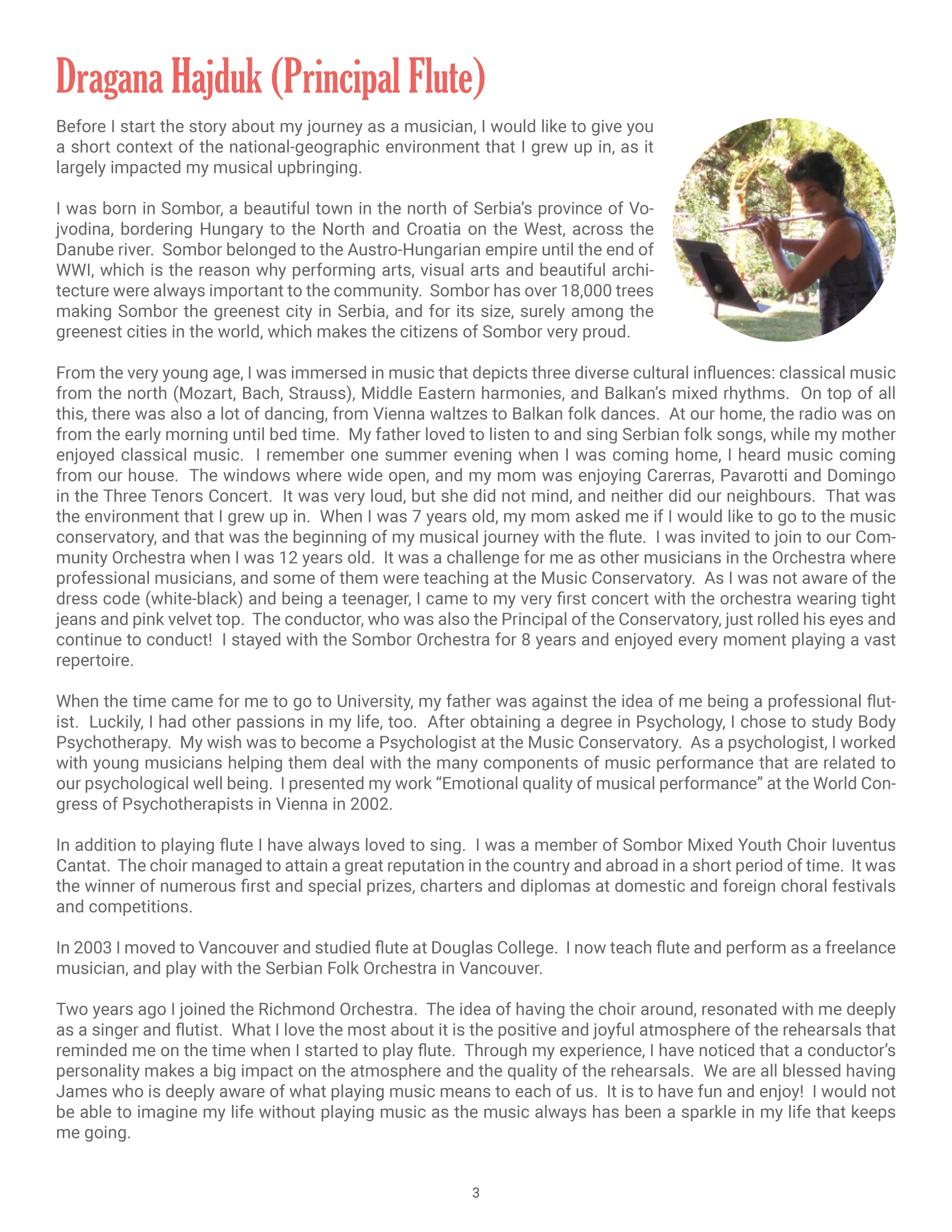
A New Season – But What’s The Singing Situation for the Chorus?

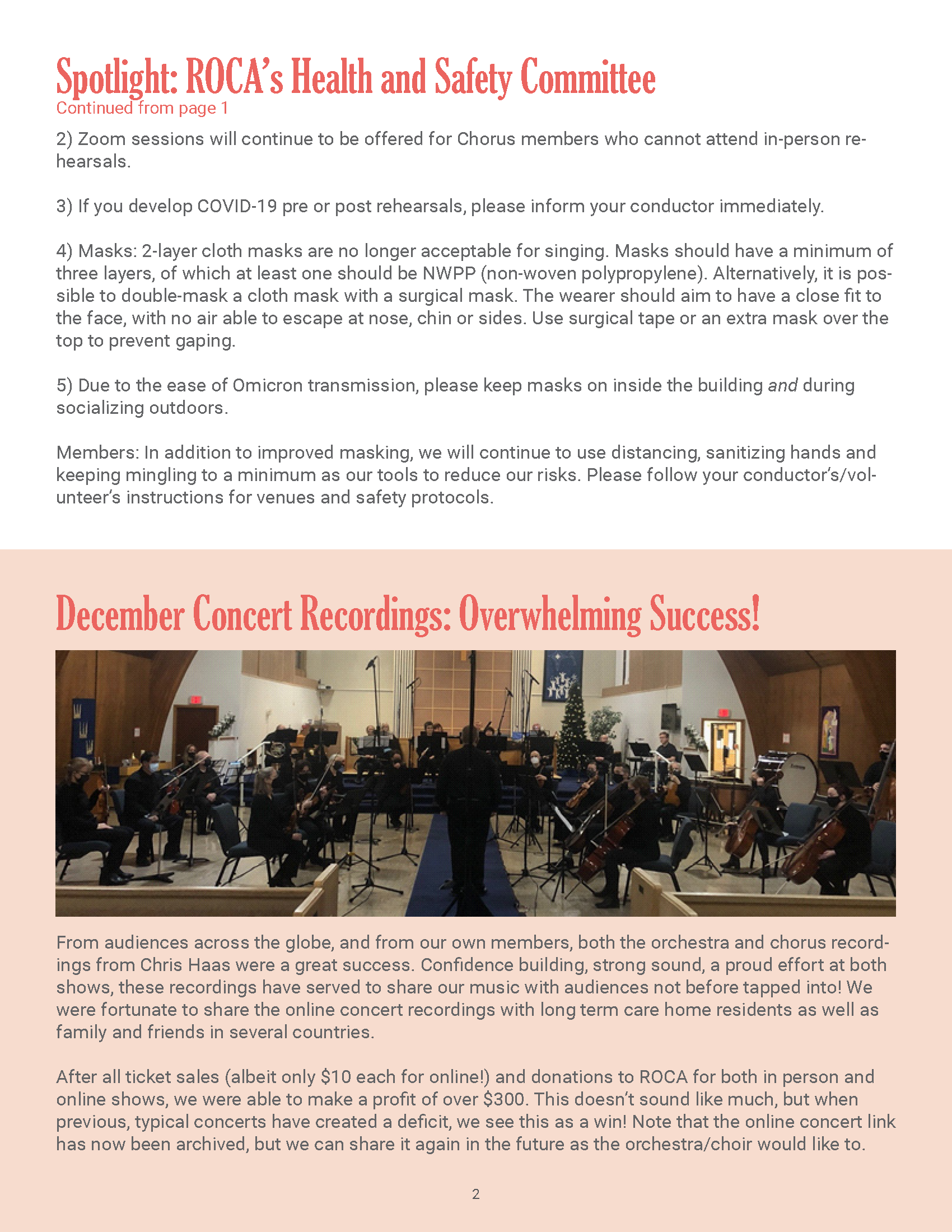
It’s hard to believe that we last sang together in March – and since then most of the choirs of the world have been on hiatus, for the good of us all.
Early in the pandemic it was established that singing was a possible conduit for passing the virus around – in fact on the same evening as our last rehearsal, a choir in Skagit County, WA also rehearsed – and within a week, more than half of them were ill, with two dying before the others recovered.
We now know that, careful as we need to be about sanitizing, we also need to be very careful around each other because, as we breathe out, our exhaled breath carries droplets and aerosols. We see this clearly on a cold day, but the fact that we don’t see it on a warm day doesn’t mean it’s not there!
Droplets are small, but large enough that they don’t go far – gravity takes over and they fall to the ground. Aerosols are tiny droplets, smaller than grains of pollen – and we’re all well aware of how that hangs suspended in the air!
So, we are encouraged to stay in our bubbles, and not be around people we don’t know without the protection of a mask.
But wait – a mask? How can you sing with a mask on?
Well, not as competently as you can without one – a singer’s face needs to be able to flex and have a loose jaw; you need to be able to breathe in without getting a mouthful of mask in your face. There is experimentation going on with a performer’s mask, boned so that there is space in front of the mouth, and fitted more closely. Everyone’s facial physiognomy is different, and ideally, everyone’s mask should be carefully fitted.
We know that some people are more at risk than others, and we have to respect their need to protect themselves. Others are confident in social connections and are ready to sing together.
I have spent the summer working on BC Choral Federation projects around all this, and taking what I hope are the most important issues for Richmond Chorus.
We are a COMMUNITY chorus – we need to bear our community in mind, and consider its needs. We have to find a way of being community even if we can’t all meet in person.
We are a community CHORUS – we need to sing. That may not be as we’ve done it in past years, but singing in unison can teach us as much as singing in parts.
We have no concerts scheduled for this season yet, and concerts are usually what we’re focused on. This season we’re going to focus on the journey and not the destination. We need to learn new things and not just new music; we need to improve our skills so that we come out of this as better musicians.
We will be working together primarily on the Zoom conferencing platform. That means that we can’t sing “together” because latency causes us to be out of synch. We will need to sing against a model or a recording, knowing that our fellow-singers are doing the same.
If it is possible, we will do some live rehearsals. These will be limited by health restrictions (wear masks, keep separation, don’t sing too long), and will be livestreamed to the singers who need to sing at home, so that nobody is forced to miss a rehearsal.
Many people have suggested we do a Virtual Choir. The problem there is that there’s very little choral about a virtual choir other than the final product; recording is done individually, and most of the work lies in the preparation and in the sound/video production. We will need to decide if it’s a good use of our financial resources.
The most important thing, though, is that we find ways to be together, in person or online. Rehearsals will be shorter – but those of us who have been meeting online through the summer have been enjoying getting to know each other in a way that isn’t always possible under regular circumstances.
So this may be an opportunity for singers to “try out” without worrying too much about auditioning; our Zoom sessions will have us singing at home, blending our voices with the leader, or with a pre-recorded track, but without the fear of “what will they think?” - because nobody else can hear you! It will be an opportunity to work on music-reading skills, and singing technique; on listening to recordings and sharing in discussions; in joining in singalongs and indulging in old favourites and new challenges.
It won’t be quite the same as it used to be – but it sure beats not singing at all!
Would-be singers can contact me at BrigidatROCA[at]gmail.com
- Brigid Coult, Chorus Director


Richmond Sings! 2020
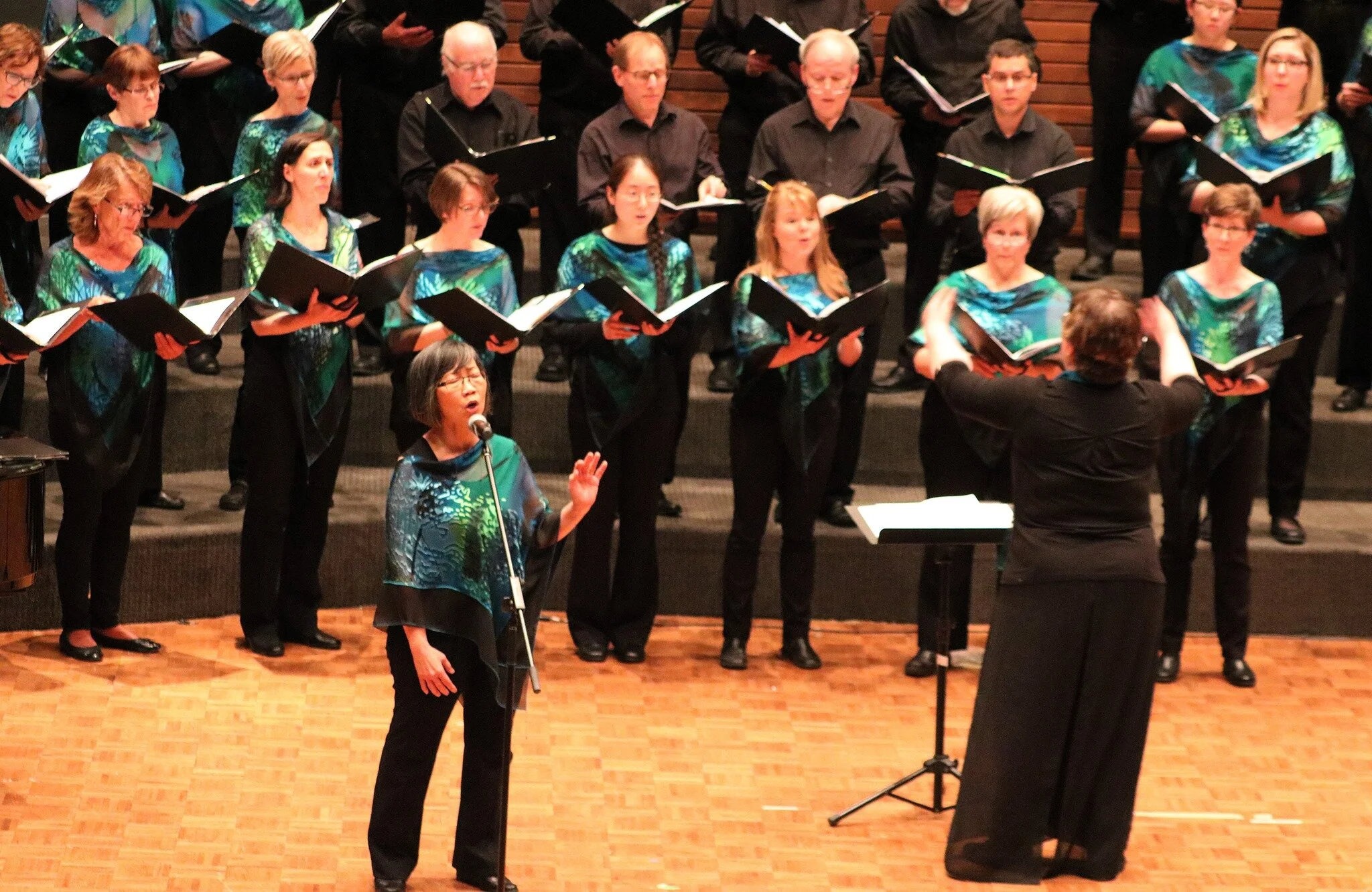
Richmond Sings! - sadly, another musical casualty of COVID-19!
Richmond Sings! has become a spring tradition — bringing singers from community, school and church together to offer their voices in support of a local charity. This year would have seen the thirteenth iteration of the event, which we usually schedule as close to the CMEA (Canadian Music Educators Association) Music Monday as possible. We have usually offered it on a Tuesday, which is our own rehearsal night, scheduled it early to allow for young participants, and kept it short!
Typically the format has called for the singing of the National Anthem together, and then choral ensembles rotate onto the stage, make their musical offerings, and make their way off to be replaced by the next ensemble. The event ends with a song from Richmond Chorus, as host choir, and then the singing of John Rutter’s arrangement of “Down By the Riverside”, with the opportunity for different sections to sing different verses while we all join in the refrain.
Participating choirs in previous years have included
from the community: Richmond Singers, Richmond Youth Honour Choir, Canada Melody Choir, Trinity Community Choir, Fuson Latina
from the schools: Westwind Elementary, General Currie Elementary, Steveston-London Secondary, Richmond Christian School, A.R MacNeill Secondary, Richmond Music School
from the churches: Gilmore Park United Choir, Our Saviour Lutheran Choir, South Arm United Choir, Brighouse United Chancel Choir
In the early days we set Richmond Sings up to benefit the Dream Auction sponsored by Gilmore Park United, and its goal of combating child poverty in Richmond. In subsequent years our support has gone to other local charities, such as Richmond Hospice and Nova House. The project has been made possible through the generosity of Fraserview Church, which has offered its facilities freely for the occasion.
We will miss lifting our voices in concert with other singers in the city for this fourteenth Richmond Sings! event, and look forward to a future in which we can sing together without fear for our health, and to benefit our community.
Brigid Coult
28 April, 2020
Rising Stars 2020: Caleb Chiu

Caleb Chiu will be performing the first movement of Lalo’s Symphonie Espagnole as a winner of the Richmond Music Festival Concerto Challenge. We asked him about the upcoming concert.
Can you tell us a bit about your path in music so far?
I started with piano when I was little but I chose the violin instead. I have always enjoyed the beautiful sound of the violin ever since I started playing it. I have been playing the violin for ten years. My most memorable performances include the 2018 Rising Stars concert with the Richmond Orchestra and the 2019 BC Provincial Music Festival in Chilliwack.
Have you played with an orchestra before?
Yes, I have performed a number of times with the Richmond Orchestra as well as the Richmond Delta Youth Orchestra.
How does music relate to other parts of your life, or vice versa?
Music is something I do everyday. It helps me relax.
What do you love most about your instrument?
I love the beautiful sound the violin can produce.
What do you love about the piece of music you will be performing?
I love the intensity and fire of this piece.
Is there something special you think the audience might listen for in your piece?
Yes, the unique Spanish rhythm defined by a set of triplets that is followed by two notes of the same length.
Vadim Repin performs Lalo’s Symphonie Espagnole with the Orchestre Philharmonique de Radio France under Myung-Whun Chung.
Rising Stars 2020: Zixu Qin

We asked Zixu (Daniel) Qin, a 17 year old Vancouver pianist about his upcoming performance of Prokofiev’s Piano Concerto 3 (third movement) as one of the Richmond Music Festival Concerto Challenge winners.
Can you tell us a bit about your path in music so far?
[ excerpted from his bio: read more about his remarkable achievements in the concert programme! ]
I started piano studies by the age of 5 in my native Beijing. By the age of 10, I completed the highest level of the Central Conservatory of Music piano examinations. After moving to Vancouver I have studied with several of Vancouver's outstanding instructors including Prof. Corey Hamm from the University of British Columbia, Dr. Boris Konovalov and Dr. Witold Wardziukiewicz. Along with many local and international awards, I have performed in venues such as Carnegie Hall, Fords and Auer Hall of Jacobs School of Music, Santa Cecilia and Hatch Hall of Eastman School of Music.
Have you played with an orchestra before?
Yes, including New Westminster Orchestra, Coquitlam Youth Orchestra and Czech's most prestigious Virtuosi Brunensis Orchestra, where I performed Rachmaninoff’s Piano Concerto No. 2.
How does music relate to other parts of your life, or vice versa?
Music is an essential part of my life as it has the power of providing reassurance during difficult times, sharing my emotional states to others in a euphemistic way as well as taking away the stress from my daily life. Furthermore, I have made my contribution to the surrounding community. I was frequently involved in various performance opportunities, mainly in volunteer performances in senior retirement houses, my school assemblies and events and many others. To the elders, as I have talked with them, Classical music reminded them of their faded memories, of all the moments in their youth and adulthood, giving them a sense of nostalgia. To the younger generation, through Classical music is believed as a decaying genre by the general public, my performances have inspired them to be passionate toward Classical music. In addition, I also become a Classical music instructor, which I began to tutor piano performance to other children in my community, not only to show how technical difficulties can be overcome, but also how to interpret music in distinct ways and how the power. I believe that Classical music can unify a community, bring joy, warmth and reassurance to people in stressful, challenging times.
What do you love most about your instrument?
I especially love the fact piano could create a great variety of timbre and tone quality through distinct methods of touching the keys, ranging from the most incisive and percussive to the most lyrical and choral-like sound. This would most likely not be achieved by other instruments like the brass and woodwind family, which the tonal qualities created are mostly monotonous with very few exceptions. I also love the fact that piano is the one and only instrument that could reach the tonal range of the lowest to the highest register, where other instruments would struggle to achieve. By that, the piano instrument is often referred to as the "king of the instruments" due to its dominance in sound projection and tone variety. I believe that this is the main reason that a piano would stand out among a huge orchestra of instruments, especially in a concerto.
What do you love about the piece of music you will be performing, and is there something special you think the audience might listen for in your piece?
I believe that the audience would most certainly enjoy the percussive nature of this Prokofiev concerto, which pertains to all his music as I mentioned previously. They will most likely notice a strong rhythmic feel in this concerto as Prokofiev has clearly indicated in the score, which contributes to the percussive feel. At the same time, I also believe that Prokofiev's choice of dissonance and intriguing (or bizarre in some way) chord progressions will definitely stand out to the audience as unusual chords are utilized in most of the music, which creates a "shock" to the audience's aural appeal.
Martha Argerich (piano) and the LSO under André Previn play Prokofiev’s Piano Concerto 3. The third movement begins at 18:25
Rising Stars 2020: Megan Cheng

Megan Cheng, in grade 10 at York House School, will be performing Tchaikovsky’s Variations on a Rococo Theme Op. 33, an exquisite showcase of cello virtuosity, as one of the winners of the Richmond Music Festival Concerto Challenge. We asked her about music and life and the cello.
Can you tell us a bit about your path in music so far?
Music has always been a big part of my life. I grew up in a Christan family and was always surrounded by music at home and in my church community. My mom plays the piano and I have an older sister who plays the violin. When I was 4, I began taking piano lessons and two years later I started the cello. I currently study cello with Joseph Elworthy at the Vancouver Academy of Music.
Have you played with an orchestra before?
When I was 9, I performed my first solo with the Richmond Delta Youth Orchestra. Mr. Malmberg was the conductor for my first solo performance and it is so neat to be able to perform with the Richmond Orchestra under his musical direction.
How does music relate to other parts of your life, or vice versa?
Music has taught me patience and perseverance as I tackle many technical demanding musical passages over the course of my musical study. The many opportunities that I have had over the years of performing in front of an audience, whether they are cello recitals, school musicals, dance shows or speech recitals has helped me to be confident and comfortable on stage. Performing is now something that I really look forward to doing.
What do you love most about your instrument?
The cello’s warm and rich sound makes it the string instrument that is closest to imitating the human voice. Its voice really speaks to me when I play.
What do you love about the piece of music you will be performing?
This piece of composition contains so many different emotions even though it is only based on a simple theme with seven variations to follow. The phrasing of the music makes it easy to express and explore every corner of the piece.
Is there something special you think the audience might listen for in your piece?
The bittersweet feeling that this piece has is a huge component that makes it remarkably meaningful. I truly hope that this music will touch your heart.
A performance of the Variations featuring Mischa Maisky (cello) and the Frankfurt Radio Symphony under Paavo Järvi.
Rising Stars 2020: Charles Wang

Charles Wang, age 10, is one of the Richmond Festival Concerto Challenge winners performing in Rising Stars 2020. We asked him about music, and his selection of the first movement of Mozart’s Piano Concerto No. 20 in D minor.
Can you tell us a bit about your path in music so far?
When I was a little kid, I loved to listen to music very much. Music makes me feel excited. For example, I kept listening to Bizet's opera Carmen. I started to learn piano at age 4, but I didn't like to practise and spent little time on the piano. Then, I stopped learning piano three times because I got tired of practising piano. At age 10, I discovered that I still love to play beautiful pieces, like Debussy's Clair de Lune and Chopin's nocturne in B flat minor. Beethoven's Sonatas make me feel inspired: he is my favourite composer of all time. Now, I love to understand the composer's feelings in order to truly play the piece's emotions correctly.
Have you played with an orchestra before?
No, I have never played with an orchestra before. It is my first time and I'm looking forward to this concert.
How does music relate to other parts of your life, or vice versa?
Music is related to many things that I enjoy. For instance, Drama is linked to music by the emotions the characters express. Literature and movies are also related to music because I can understand more deeply the feelings of the author and writer of the script. Even figure skating is linked to music because the type of music determines how the skater moves and dances. Learning music helps me to be very aware about details, like in math, and encourages me to do better.
What do you love most about your instrument?
The piano has a variety of beautiful sounds and textures that I like most. The pedal is also an important part of the piano to add more suspense or make the piece more decorative and melodic, especially in impressionist music. Also the piano can copy the sounds that instruments of the orchestra can make, so the piano is a special and interesting instrument.
What do you love about the piece of music that you will be performing?
I love the sorrowful feeling of this concerto and the melodic, legato passages. It was written in the late years of Mozart and explains his suffering of constant stress, illness, and his poverty. The concerto begins in a gloomy key of D minor in the dynamic piano that gradually builds up to a full forte. in the development section, the key changes to F major, but never becomes jubilant. The cadenza is very exciting; many composers wrote cadenzas for this concerto, including Beethoven.
Is there something special you think the audience might listen for in your piece?
I would recommend listening to the cadenza. It is very powerful and very unique because it is written by Beethoven. This cadenza is full of surprises and fits perfectly in this gloomy concerto.
Martha Argerich (piano) and Alexandre Rabinovitch with the Orchestra di Padova e del Veneto. This recording features Beethoven’s cadenzas for Mozart’s Piano Concerto No. 20 in D minor.

2019/2020 Concert Season: Subscriptions Available!
Season 34 is another year of great music, from Mozart to the Beatles, a trip around the Pacific Rim, and many favourite features. Subscribe now!
Welcome to the 34th season of the Richmond Orchestra and Chorus!
We have some wonderful concerts lined up for 2019/2020, beginning in November with Amadeus — Mozart’s Final Year. The Requiem Mass is a piece of sublime beauty and poignancy, his last work and left unfinished at his tragic and untimely death in 1791. This was only one of many masterpieces from that year, which include the Magic Flute (whose thrilling overture we will begin with) and the sparkling and lyrical Clarinet Concerto. We are thrilled to welcome Stephen Robb as the soloist, whose work as an arranger-orchestrator we have also featured in several past seasons (including our rendition of Bohemian Rhapsody this past April!).
Moving on to Christmas, the choir and orchestra will come together again with a concert spanning centuries, from Charpentier’s beloved Baroque Messe de Minuit to Tchaikovsky’s Nutcracker Suite, from songs of the Golden Age of Hollywood to carols we all know and love.
In February, in partnership with the Richmond Music Festival the orchestra will again present Rising Stars, featuring winners of the Concerto Challenge performing a selection of virtuosic works across the repertoire. These young musicians are truly the stars of tomorrow, and it’s always a thrill to see them as they start to take flight.
The choir will take us on a journey around the Ring of Fire in March, exploring folksongs from all around the Pacific Rim. From the indigenous cultures of BC across to China, Japan, the Philippines and Indonesia, then down to Australia, New Zealand and Samoa, and back across the ocean to Ecuador and working our way back home, it will be a breathtaking musical adventure!
Libby Yu takes the stage in April, performing Rachmaninoff’s Rhapsody on a Theme of Paganini, an extraordinary virtuosic work for piano and orchestra. Amongst the many variations there is possibly the most famous, soaring, heart-breaking melody of all time! As 2020 is the 250th anniversary of Beethoven’s birth the orchestra will also play the mighty Symphony No. 5, a work of staggering intensity spun from a single four note motif — perhaps the single best known snippet of music of all.
We always finish the season with a grand crowd-pleasing gala finale, and next year will be no exception as we let our hair down, sixties-style, with a Beatles evening. Let It Be will see the choir and orchestra joined by The Fab Fourever to present a magical mystery tour through the Beatles’ best loved hits, from Please Please Me all the way to Let It Be.
If these sound intriguing then consider a season subscription, to get a discounted rate to all six concerts — plus extra perks such as 30% off additional tickets and an invitation to our end-of-year reception!
Looking forward to seeing you at a concert soon,
Adele Armstrong, President

Bohemian Rhapsody

Last season, we were especially lucky to perform the Korngold violin concerto with Nancy DiNovo, and we are thrilled this season to welcome her back to play the electrifying Dvorak violin concerto! Continuing the Czech/Bohemian theme, we will also play Smetana’s beloved Moldau which musically depicts the river which flows through the country, and three of Dvorak’s Slavonic Dances.
And with a concert titled “Bohemian Rhapsody” we couldn’t resist throwing in a little something extra, with the choir joining forces…
Come see it Saturday April 27, 7:30pm at Fraserview church!

The Illumination of Jewish Music
On March 10, 2019, 3:00pm, at South Arm United Church, the Richmond Orchestra and Chorus Association (ROCA) will be performing “Sing Shalom!”, a concert devoted to Jewish music.
As a ROCA chorus member, this concert has special personal significance for me. For most of my adult life, I did not know that I was Jewish. In my maternal line are three generations of Ukrainian/Polish Jews who chose to be Canadians, beginning with my great-grandparents who fled pogroms and other forms of persecution in Eastern Europe for the hope of survival in a new land.
On March 10, 2019, 3:00pm, at South Arm United Church, the Richmond Orchestra and Chorus Association (ROCA) will be performing “Sing Shalom!”, a concert devoted to Jewish music.
As a ROCA chorus member, this concert has special personal significance for me.
For most of my adult life, I did not know that I was Jewish.
In my maternal line are three generations of Ukrainian/Polish Jews who chose to be Canadians, beginning with my great-grandparents who fled pogroms and other forms of persecution in Eastern Europe for the hope of survival in a new land.
Still terrified in the new country that seemed so big and strange, they tweaked their Jewish names and successfully lived as “Canadian Jews in hiding” for many years – until, as a fourth-generation adult in the family, I discovered, by accident, my Jewish background.
I chose to embrace Judaism and was moved by the warm welcome from the Jewish community. Today I live as a Jewish person unafraid to openly attend synagogue services and celebrate religious holidays. I know that this is because Canada has evolved through the years, with a Charter of Rights and Freedoms that recognizes and protects the rights of all persons. This is a privilege no one should take for granted.
ROCA is a secular community orchestra and choir composed largely of non-Jewish members, and so its decision to celebrate Jewish music in “Sing Shalom!” is another inspiring sign of my great fortune to be a Canadian.
This concert explores a wealth of Jewish music, from the haunting melodies in Eric Whitacre’s “Five Hebrew Love Songs” through the magnificence of Aaron Copland’s “In the Beginning” (a telling of the Genesis story of creation) to folk songs in both Hebrew and Yiddish. One of the folk songs, “Oyfn Pripetshik”, is still sung to children in Jewish homes and kindergartens - it is one that years ago my mother and grandmother dared not sing to me. And so, it brings me great joy to feel free to sing it (in my heart for them) together with my friends, in public, as part of the Richmond Orchestra and Chorus.
Enjoy this vivid illumination of Jewish music!
- Heather M.
Concert Details
Sing Shalom!
Sunday, March 10, 2019
3:00PM - 5:30PM
South Arm United Church
11051 Number 3 Road Richmond, BC, V7A 1X3
TICKETS
If you would like to take advantage of our online prices but would prefer to order over the phone, please call our office at 604-276-2747 and we will facilitate your order.
Door Tickets:
Adult: $25.00
Senior: $20.00
Student: $20.00
Child (under 13): $10.00
Online Tickets:
Adult: $20.00
Senior: $16.00
Student: $15.00
Child (under 13): $8.00

Nathan Kwok - Cellist and 2019 Rising Star
Nathan Kwok began learning the cello when he was 9 years old and his passion for the instrument has steadily increased over the years. He and has been section leader in the Magee Secondary School Orchestra since 2016 and currently studies with Dr. Janelle Ragno. Nathan’s musical accomplishments are many. In 2016, he was the principal cello and quartet soloist of the BC Music Educators Association Honour Orchestra. He was a member of the Vancouver Youth Symphony Orchestra 2012-2016, and was cello co-principal of the Intermediate Orchestra 2015-2016. A chamber music enthusiast, he participated in the Quiring Chamber Music Camp and Quartet Fest West at the University of Victoria, and now plays in the chamber program at the Vancouver Academy of Music.
Nathan Kwok began learning the cello when he was 9 years old and his passion for the instrument has steadily increased over the years. He and has been section leader in the Magee Secondary School Orchestra since 2016 and currently studies with Dr. Janelle Ragno. Nathan’s musical accomplishments are many. In 2016, he was the principal cello and quartet soloist of the BC Music Educators Association Honour Orchestra. He was a member of the Vancouver Youth Symphony Orchestra 2012-2016, and was cello co-principal of the Intermediate Orchestra 2015-2016. A chamber music enthusiast, he participated in the Quiring Chamber Music Camp and Quartet Fest West at the University of Victoria, and now plays in the chamber program at the Vancouver Academy of Music.
In addition to all these amazing achievements, Nathan says “My most important accomplishment to date is the RCM Grade 10 cello examination which I played last year, and for which I achieved First Class Honours with Distinction. This was my first RCM exam and it took a lot of focused, determined practice over an extended period of time to learn the repertoire, not to mention the scales, arpeggios and orchestral excerpts. After much hard work, it was gratifying to be able to perform the full repertoire for the examiner.” Although Nathan has performed with many different orchestras over the years he is looking forward to performing Saint-Saëns Cello Concerto No. 1 in A minor, Op. 33, 1st movement and Coda with the Richmond Orchestra as, he notes, amateur musicians rarely have the opportunity to perform a concerto with an orchestra. Nathan’s goal is to “play the piece as Saint-Saëns wrote it --- with intricate interplay of sounds and colours between the cello and the orchestra”. He goes on to say that “to be able to perform with an orchestra will give me a fresh perspective on the concerto, as I will learn to look for all the different voices that make up the music. It will be ear-opening to hear different instruments from the orchestra playing with me, rather than just the sound of the piano.”
Saint-Saëns wrote the Cello Concerto no. 1 in A minor, Op. 33 in 1872 and it is considered by many composers to be the greatest cello concerto of all time. The concerto is technically very demanding and Nathan has enjoyed overcoming the challenges of the piece through persistent and patient practice. His performance at the Rising Stars concert will be a memorable occasion.
CONCERT DETAILS AND TICKETS
Rising Stars 2019
Saturday, February 16, 2019
7:30 PM 9:30 PM
Fraserview MB Church
11295 Mellis Drive Richmond, BC, V6X 1L8
If you would like to take advantage of our online prices but would prefer to order over the phone, please call our office at 604-276-2747 and we will facilitate your order.
Door Tickets:
Adult: $25.00
Senior: $20.00
Student: $20.00
Child (under 13): $10.00
Online Tickets:
Adult: $20.00
Senior: $16.00
Student: $15.00
Child (under 13): $8.00